The Upstream Hydrogen Process
Oil & Gas Companies can produce hydrogen Upstream at the sites of their existing gas processing plants, using proven technology to produce hydrogen today e.g. steam methane reforming (SMR).
CO2, the by-product of hydrogen manufacture is captured, together with CO2 emissions from energy provision at the site. The CO2 is compressed and injected into the periphery (the edges/bottom) of the producing gas field. Co-location of gas processing and low-carbon hydrogen production increases the efficiencies of the processes both above and below ground.
The hydrogen produced is transported via pipeline to industrial customers who require hydrogen to make a wide range of vital products e.g. ammonia, methanol, petroleum products, steel and for desulphurisation.
The Starting Point: A Producing Gas Field
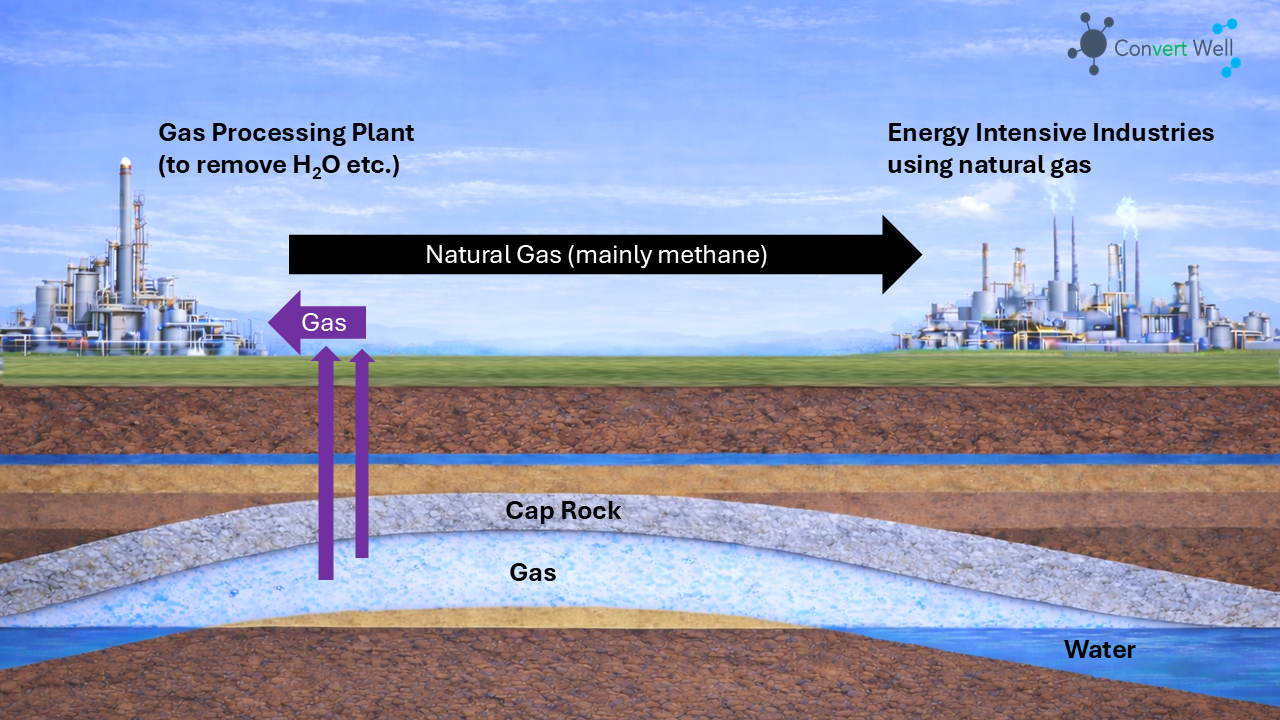
Take an existing gas field (an onshore field is illustrated here) with gas wells and gas processing to remove impurities: H2O, Nitrogen, H2S, perhaps naturally occurring CO2.
Today the purified natural gas is sold, almost exclusively by pipeline, to the customers who use natural gas:
to reform the gas molecules to manufacture some 70 million tons per year of high carbon (Grey) Hydrogen. The other 30 million tonnes per year is Brown Hydrogen, produced from coal. Our process can tackle that as well, but it would involve coal gasification followed by the currently described process.
gas is used in chemicals manufacture and as the reduction agent in steel production.
and/or gas is burnt to prodcue the intense heat required in the manufacture of products such as hydrogen, glass, ceramics, cement, and traditional steel manufacture.
Switching to Hydrogen Production
The gas field can be adapted to produce hydrogen by bringing a hydrogen production unit (HPU) to the site of the gas processing plant that is right-sized for the volume of gas being produced.
A steam methane reformer (SMR) is the most common HPU from natural gas, although more efficient processes, such as Autothermal Reforming (ATR) are of course also available.
Using the purified natural gas as feedstock for the HPU, the hydrogen produced can then be sold to industrial customers who need the hydrogen molecule. It can also be used as a low-carbon fuel, if desired.
Hydrogen for industrial use is a significantly more valuable product than natural gas. Due to the lower cost of manufacture, subsidies are not usually required and value is added to the company.
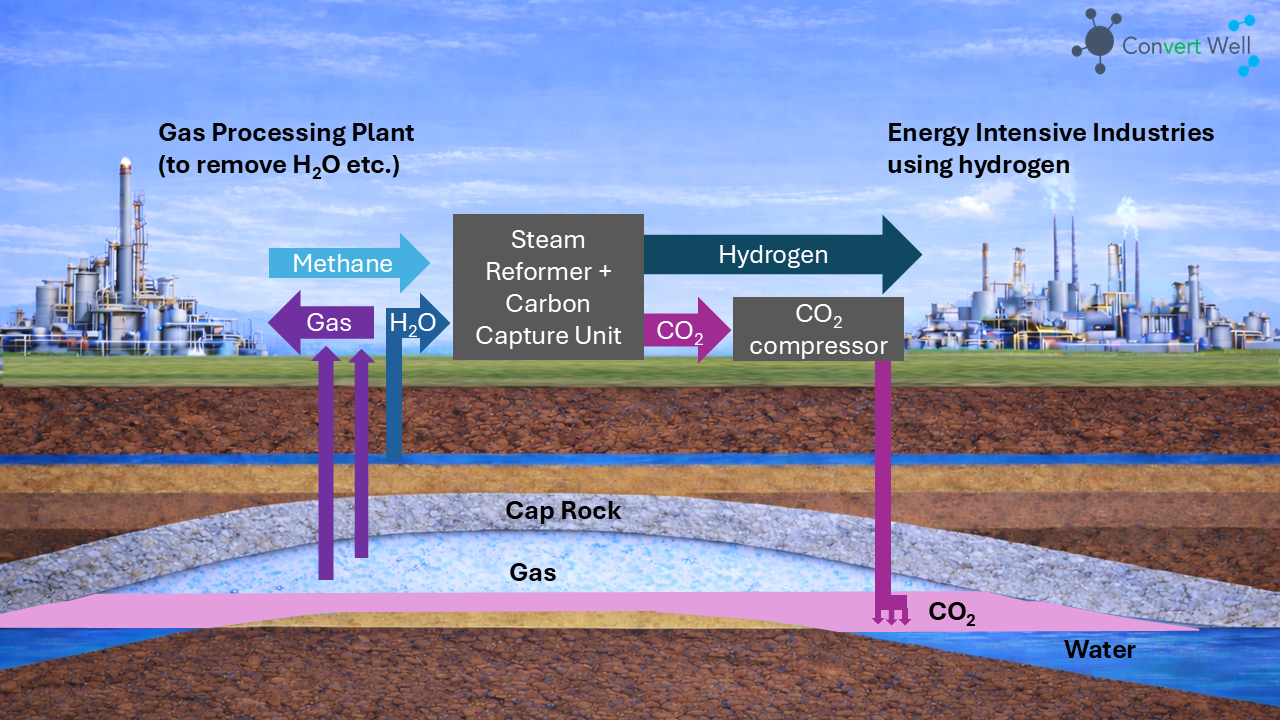
CO2 by-product from the HPU and CO2 from the hydrogen manufacturing process is captured by adding carbon capture unit(s), right sized for the field. To increase the volumes of CO2 available for injection (and further reduce the carbon footprint), CO2 emissions from the existing gas processing site can also be captured.
The circle is closed by compressing the CO2 and injecting all CO2 volumes deep in the gas field (at the edges/periphery/down-dip) via a small number (two or three) newly drilled vertical or horizontal CO2 injection wells.
Hydrogen transportation is a critical part of the process, and is 24/7 reliable through pipeline. Pipeline ‘line-pack’ (the pressurised volume in the pipeline) can provide hydrogen during interruptions to the process. That means that additional hydrogen storage is minimised.
Hydrogen can be transported via:
the existing natural gas line if the pipeline is ‘hydrogen-ready’;
a natural gas pipeline that is relined to become ‘hydrogen-ready’;
a relatively short new hydrogen pipeline to connect into an in-country hydrogen pipeline network to an industrial complex;
blended with natural gas from other fields, piped and unblended at the industrial complex for companies requiring the hydrogen molecule for their process.